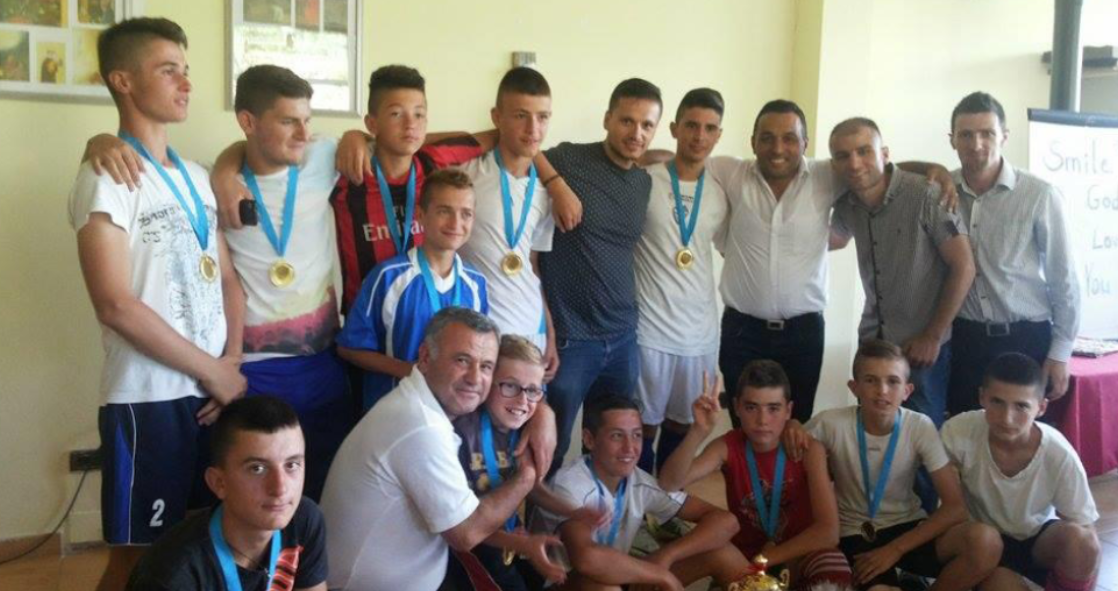
Albania is a pioneer ministry of Youth for Christ.
A national steering committee has recently been established and they are planning and preparing to start youth ministry in the country.
Please pray for them as they do this.
For further information please contact the EMENA Area Office.
About Albania
Albania
Introduction
Albania declared its independence from the Ottoman Empire in 1912, but was conquered by Italy in 1939. Communist partisans took over the country in 1944. Albania allied itself first with the USSR (until 1960), and then with China (to 1978). In the early 1990s, Albania ended 46 years of xenophobic Communist rule and established a multiparty democracy. The transition has proven challenging as successive governments have tried to deal with high unemployment, widespread corruption, a dilapidated physical infrastructure, powerful organized crime networks, and combative political opponents. Albania has made progress in its democratic development since first holding multiparty elections in 1991, but deficiencies remain. International observers judged elections to be largely free and fair since the restoration of political stability following the collapse of pyramid schemes in 1997; however, there have been claims of electoral fraud in every one of Albania's post-communist elections. In the 2005 general elections, the Democratic Party and its allies won a decisive victory on pledges to reduce crime and corruption, promote economic growth, and decrease the size of government. The election, and particularly the orderly transition of power, was considered an important step forward. Albania joined NATO in April 2009 and is a potential candidate for EU accession. Although Albania's economy continues to grow, the country is still one of the poorest in Europe, hampered by a large informal economy and an inadequate energy and transportation infrastructure.
Geography
Location
Location: Southeastern Europe, bordering the Adriatic Sea and Ionian Sea, between Greece in the south and Montenegro and Kosovo to the north
Geographic Coordinates: 41 00 N, 20 00 E
Area
Total Area: 28,748 sq km Rank: 144
Land Area: 27,398 sq km
Water Area: 1,350 sq km
Comparison: slightly smaller than Maryland
Land Boundaries: 717 km
Bordering Countries: Greece 282 km, Macedonia 151 km, Montenegro 172 km, Kosovo 112 km
Coastline: 362 km
Climate
mild temperate; cool, cloudy, wet winters; hot, clear, dry summers; interior is cooler and wetter
Terrain
mostly mountains and hills; small plains along coast
Elevations
Lowest Point: Adriatic Sea 0 m
Highest Point: Maja e Korabit (Golem Korab) 2,764 m
Natural Resources
petroleum, natural gas, coal, bauxite, chromite, copper, iron ore, nickel, salt, timber, hydropower
Land Use
Arable land: 20.1%
Permanent Crops: 4.21%
Other: 75.69% (2005)
Irrigated Land: 3,530 sq km (2003)
Renewable Water Resources: 41.7 cu km (2001)
Total Freshwater withdrawal (domestic/industrial/agricultural): 1.71 cu km/yr (27%/11%/62%)
Freshwater Withdrawal Per Capita: 546 cu m/yr (2000)
Environment
Natural Hazards: destructive earthquakes; tsunamis occur along southwestern coast; floods; drought
Environmental Issues: deforestation; soil erosion; water pollution from industrial and domestic effluents
Environmental Agreements: Party to: Air Pollution, Biodiversity, Climate Change, Climate Change-Kyoto Protocol, Desertification, Endangered Species, Hazardous Wastes, Law of the Sea, Ozone Layer Protection, Wetlands
Geography Notes
strategic location along Strait of Otranto (links Adriatic Sea to Ionian Sea and Mediterranean Sea)
People
Population: 3,639,453 (July 2010 est.) Rank: 129
Age Structure
0-14 years: 23.1% (male 440,528/female 400,816)
15-64 years: 67.1% (male 1,251,001/female 1,190,841)
65 years and over: 9.8% (male 165,557/female 190,710) (2010 est.)
Median Age: 28.9 years
Population Growth
Growth Rate: 0.546% (2010 est.) Rank: 153
Birth Rate: 15.29 births/1,000 population (2010 est.) Rank: 138
Death Rate: 5.55 deaths/1,000 population (July 2010 est.) Rank: 174
Net Migration Rate: -4.28 migrant(s)/1,000 population (2010 est.) Rank: 158
Urbanization
Urban Population: 47% of total population (2008)
Rate of Urbanization: 1.9% annual rate of change (2005-10 est.)
Life and Death
Infant Mortality Rate: 18.62 deaths/1,000 live births Rank: 107
Life Expectancy at Birth: 77.96 years Rank: 50
Fertility Rate: 2 children born/woman (2010 est.) Rank: 128
Health and Disease
HIV/AIDS - Adult Prevalence Rate NA
People living with HIV/AIDS: NA
HIV/AIDS Deaths: NA
Nationality and Culture
Noun: Albanian(s)
Adjective: Albanian
Ethnic Groups: Albanian 95%, Greek 3%, other 2% (Vlach, Roma (Gypsy), Serb, Macedonian, Bulgarian) (1989 est.)
Note: in 1989, other estimates of the Greek population ranged from 1% (official Albanian statistics) to 12% (from a Greek organization)
Religion: Muslim 70%, Albanian Orthodox 20%, Roman Catholic 10%
Note: percentages are estimates; there are no available current statistics on religious affiliation; all mosques and churches were closed in 1967 and religious observances prohibited; in November 1990, Albania began allowing private religious practice
Languages: Albanian (official - derived from Tosk dialect), Greek, Vlach, Romani, Slavic dialects
Education
Literacy (age 9 and over can read and write): 98.7% Male: 99.2% Female: 98.3% (2001 census)
School life expectancy (primary to tertiary education): 11 years Male: 11 years Female: 11 years (2004)
Education expenditures: 2.9% of GDP (2002) Rank: 147
Government
Country Name
Conventional Long Form: Republic of Albania
Conventional Short Form: Albania
Local Long Form: Republika e Shqiperise
Local Short Form: Shqiperia
Formerly: People's Socialist Republic of Albania
Government Type: republic
Capital: Tirana (Tirane) Geographic Coordinates: 41 19 N, 19 49 E
Administrative divisions
12 counties (qarqe, singular - qark); Berat, Diber, Durres, Elbasan, Fier, Gjirokaster, Korce, Kukes, Lezhe, Shkoder, Tirane, Vlore
Independence: 28 November 1912 (from the Ottoman Empire)
National holiday: Independence Day, 28 November (1912)
Constitution: approved by parliament on 21 October 1998; adopted by popular referendum on 22 November 1998; promulgated 28 November 1998
Legal system: has a civil law system; has not accepted compulsory ICJ jurisdiction; has accepted jurisdiction of the International Criminal Court for its citizens
Suffrage: 18 years of age; universal
Executive Branch
Chief of State: President of the Republic Bamir TOPI (since 24 July 2007)
Head of Government: Prime Minister Sali BERISHA (since 10 September 2005)
Cabinet: Council of Ministers proposed by the prime minister, nominated by the president, and approved by parliament
Elections: president elected by the Assembly for a five-year term (eligible for a second term); four election rounds held between 8 and 20 July 2007 (next election to be held in 2012); prime minister appointed by the president
Election Results: Bamir TOPI elected president; Assembly vote, fourth round (three-fifths majority, 84 votes, required): Bamir TOPI 85 votes, Neritan CEKA 5 votes
Legislative Branch
unicameral Assembly or Kuvendi (140 seats; 100 members elected by direct popular vote and 40 by proportional vote to serve four-year terms)
Elections: last held on 28 June 2009 (next to be held in 2013)
Election Results: percent of vote by party - NA; seats by party - PD 68, PS 64, LSI 4, other 4
Note: Parliament in November 2008 approved an electoral reform package that transformed the electoral system from a majority system to a regional proportional system; the code also established an electoral threshold limiting smaller party representation
Judicial branch
Constitutional Court, Supreme Court (chairman is elected by the People's Assembly for a four-year term) and multiple appeals and district courts
Politics
Political Parties and Leaders: Agrarian Environmentalist Party or PAA [Lufter XHUVELI]; Christian Democratic Party or PDK [Nard NDOKA]; Communist Party of Albania or PKSH [Hysni MILLOSHI]; Democratic Alliance Party or AD [Neritan CEKA]; Democratic Party or PD [Sali BERISHA]; G99 Political Movement [Erion VELIAJ]; Liberal Union Party or BLD [Arjan STAROVA]; National Front Party (Balli Kombetar) or PBK [Artur ROSHI]; New Democratic Party or PDR [Genc POLLO]; Republican Party or PR [Fatmir MEDIU]; Social Democracy Party of Albania or PDSSh [Paskal MILO]; Social Democratic Party or PSD [Skender GJINUSHI]; Socialist Movement for Integration or LSI [Ilir META]; Socialist Party or PS [Edi RAMA]; Socialist Party 1991 [Petro KOCI]; Union for Human Rights Party or PBDNj [Vangjel DULE]
Political Pressure Groups and Leaders: Citizens Advocacy Office [Kreshnik SPAHIU]; Confederation of Trade Unions of Albania or KSSH [Kastriot MUCO]; Front for Albanian National Unification or FBKSH [Gafur ADILI]; Mjaft Movement; Omonia [Jani JANI]; Union of Independent Trade Unions of Albania or BSPSH [Gezim KALAJA]
International Organization Participation: BSEC, CE, CEI, EAPC, EBRD, FAO, IAEA, IBRD, ICAO, ICCt, ICRM, IDA, IDB, IFAD, IFC, IFRCS, ILO, IMF, IMO, Interpol, IOC, IOM, IPU, ISO (correspondent), ITU, ITUC, MIGA, MINURCAT, NATO, OIC, OIF, OPCW, OSCE, SECI, UN, UNCTAD, UNESCO, UNIDO, UNWTO, UPU, WCO, WFTU, WHO, WIPO, WMO, WTO
Flag Description: red with a black two-headed eagle in the center; the design is claimed to be that of 15th-century hero George Castriota SKANDERBERG, who led a successful uprising against the Turks that resulted in a short-lived independence for some Albanian regions (1443-1478)
Economy
Economy Overview: Albania, a formerly closed, centrally-planned state, is making the difficult transition to a more modern open-market economy. Macroeconomic growth averaged around 6% between 2004-08, but declined to about 4% in 2009. Inflation is low and stable. The government has taken measures to curb violent crime, and recently adopted a fiscal reform package aimed at reducing the large gray economy and attracting foreign investment. The economy is bolstered by annual remittances from abroad representing about 15% of GDP, mostly from Albanians residing in Greece and Italy; this helps offset the towering trade deficit. The agricultural sector, which accounts for over half of employment but only about one-fifth of GDP, is limited primarily to small family operations and subsistence farming because of lack of modern equipment, unclear property rights, and the prevalence of small, inefficient plots of land. Energy shortages because of a reliance on hydropower, and antiquated and inadequate infrastructure contribute to Albania's poor business environment and lack of success in attracting new foreign investment needed to expand the country's export base. The completion of a new thermal power plant near Vlore has helped diversify generation capacity, and plans to upgrade transmission lines between Albania and Montenegro and Kosovo would help relieve the energy shortages. Also, with help from EU funds, the government is taking steps to improve the poor national road and rail network, a long-standing barrier to sustained economic growth.
Gross Domestic Product
GDP (purchasing power parity): $23.12 billion (2009 est.) Rank: 116
Note: Albania has an informal, and unreported, sector that may be as large as 50% of official GDP
GDP - real growth rate: 4.2% (2009 est.) Rank: 42
GDP - per capita (PPP): $6,400 (2009 est.) Rank: 131
GDP - Composition by Sector: Agriculture: 21.5% Industry: 19.5% Services: 59% (2009 est.)
Labor Force
Labor Force: 140 Rank: 1.103 million (2009 est.)
Labor force - by occupation: Agriculture: 58% Industry: 15% Services: 27% (September 2006 est.)
Unemployment Rate: 12.8% (2009 est.) Rank: 12.8% (2008 est.)
Note: these are official rates, but actual rates may exceed 30% due to preponderance of near-subsistence farming
Poverty
Population below poverty line: 25% (2004 est.)
Transnational Issues
International Disputes: the Albanian Government calls for the protection of the rights of ethnic Albanians in neighboring countries, and the peaceful resolution of interethnic disputes; some ethnic Albanian groups in neighboring countries advocate for a "greater Albania," but the idea has little appeal among Albanian nationals; the mass emigration of unemployed Albanians remains a problem for developed countries, chiefly Greece and Italy
